


-
Claude Mythos and DeFi: Real threat or overblown fear?
When Anthropic introduced Claude Mythos-class models as its most advanced AI system for cybersecurity, it drew the usual mix of reactions from crypto communities. The lineup included Claude Fable 5, a Mythos-class model intended for broad use, although access was later suspended after a US government directive.
The concern around decentralized finance (DeFi) was easy to understand. If AI systems can find software flaws faster and with less human input, attackers may also use them to spot weak points in protocols before security teams can fix them.
Those concerns may seem overstated, but they come from a real shift in technology. AI tools have become better at reviewing code, spotting flaws and supporting security teams. At the same time, DeFi remains a major target for attackers because its code is often public, its protocols hold large amounts of money and many systems are new or not fully battle-tested.
The key question is whether Claude Mythos and similar tools pose a serious threat to DeFi, or whether the industry is overstating what today’s AI can actually do.
The answer sits somewhere between the hype and the alarm.
-
What is Claude Mythos?
Claude Mythos is Anthropic’s most advanced AI system for cybersecurity. Unlike general-purpose AI assistants that can write code or explain technical concepts, Mythos is designed to handle complex security tasks.
Anthropic initially limited access to the model instead of releasing it widely. According to the company, Mythos showed clear improvements in vulnerability research, exploit analysis and layered cybersecurity reasoning compared with earlier versions.
That capability drew attention quickly because vulnerability detection is valuable in both cybersecurity and crypto.
A security expert might spend weeks reviewing code for small flaws. If AI can shorten that timeline to hours, or even less, it could change the balance in defensive security.
That possibility explains much of the unease in crypto circles.
-
Why Claude Mythos matters to DeFi
DeFi has lost billions of dollars to hacks, exploits and protocol failures in recent years. The concern is not new.
Flash-loan attacks, cross-chain bridge exploits, governance attacks and smart contract bugs have shown that even audited protocols can still have gaps.
Unlike traditional software systems, DeFi protocols often control large amounts of money through smart contracts. A vulnerability may not just expose information. It could allow attackers to move funds quickly and without permission.
That makes DeFi especially attractive to malicious actors.
The open-source nature of many blockchain projects adds another risk. Their code is available for security teams to review, but it is also available to attackers.
In the past, finding advanced vulnerabilities required deep technical skill. Security researchers needed strong knowledge of coding languages, blockchain architecture, cryptography and attack methods.
AI changes that.
Instead of manually reviewing large codebases, analysts can now use AI assistants to flag suspicious patterns, summarize complex systems and point out possible attack paths.
This is where concerns around Claude Mythos begin.
Did you know? In some controlled security competitions, AI systems have identified software vulnerabilities in minutes that would normally take human researchers several hours, or even days, to find.
-
Can AI really find vulnerabilities in DeFi protocols?
The short answer is yes. AI systems have already shown that they can find certain types of software vulnerabilities.
Studies from Anthropic and other research groups show that advanced models can review code repositories, test security assumptions and sometimes find issues that human analysts miss.
Smart contracts are well suited to this kind of analysis because they are often public and written in structured languages such as Solidity.
An AI system can quickly review thousands of contracts, spot repeated patterns and look for known types of vulnerabilities.
Areas where AI is likely to provide growing support include:
- Reviewing audit reports
- Identifying unsafe coding practices
- Comparing protocol upgrades
- Detecting permission errors
- Modeling possible exploit paths
- Analyzing interactions between smart contracts
AI is becoming a force multiplier for security researchers. A task that once required a full team of experts could increasingly be handled by a smaller group of security professionals using advanced AI tools.
That is a meaningful change, not just marketing hype.
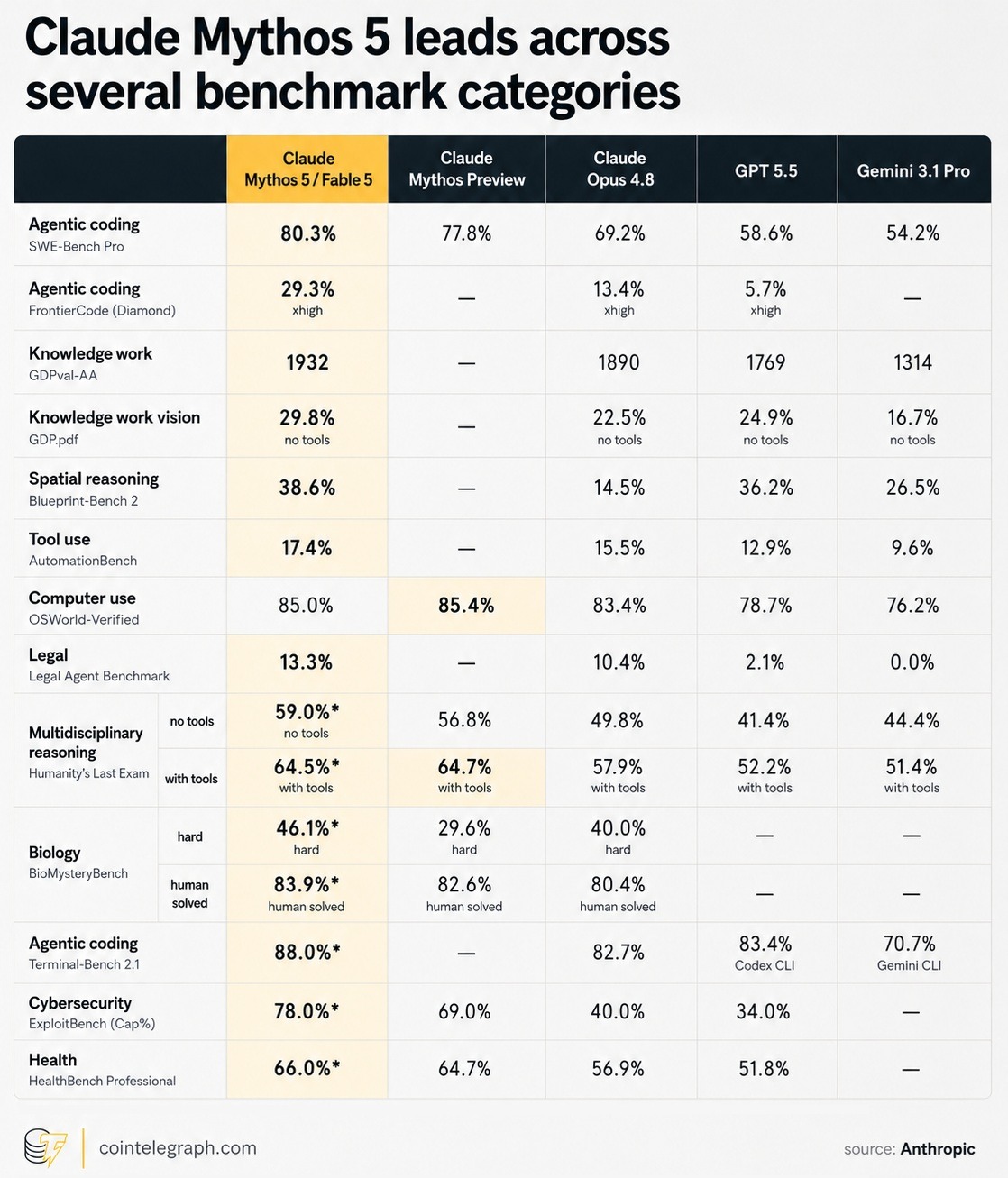
The table below shows how Claude Mythos compares with other models:

-
Why AI threats to DeFi may be exaggerated
Even with these advances, there is a clear difference between finding a vulnerability and stealing funds. Many crypto attacks involve much more than spotting a flaw.
Attackers often need to:
- Understand complex protocol mechanics
- Bring in significant capital
- Coordinate multiple transactions
- Exploit market…
cointelegraph.com