


Bitcoin’s biggest challenge may lie in making the blockchain post-quantum.
Experts in the field believe a quantum computer could emerge in the next decade. With BIP-360 co-author Ethan Heilman estimating the rollout of post-quantum could take seven years, time is running out to reach a consensus on the way ahead
Here are the biggest issues and obstacles Bitcoiners face:
1: Gaining agreement
2. Doing nothing has risks too
3. Post-quantum signature sizes are massive
4. Signature size solutions are radical for Bitcoin
5. Migrating coins to post-quantum addresses will take forever
6. What to do with coins that can’t upgrade?
Bitcoin’s quantum problem #1: Gaining agreement
There’s a high degree of confidence that the technical problems can be solved. But it’s more doubtful that Bitcoiners will be able to agree on the changes required in time. Bitcoiners have gone to war over increasing the block size, which led to the creation of Bitcoin Cash, and are still fighting over the downstream effects of the Taproot upgrade in November 2021.
“The main hurdle is the decentralized nature of Bitcoin and getting consensus,” Charles Edwards, founder of Capriole Investments, tells Magazine. He says prominent quantum skeptics are blocking momentum for action. “Like you have people — Adam Back — saying we’re 40 years away, which is just complete nonsense, like fantasy land commentary.”
Another advocate for change, Castle Island founder Nic Carter, claims that nine out of the top ten most influential Bitcoin devs have downplayed the threat, failed to express a view, or suggested there’s no urgency.

Bitcoin Core contributor James O’Beirne summed up the attitude of many in the Bitcoin community on the Stephan Livera Podcast this week.

“I would say there are way better uses of our time as developers. There’s kind of an infinite list of things that we could be working on and for me, you know, quantum doesn’t even breach the top 100 things when it comes to Bitcoin.”
Like many skeptics, he suspects proponents of change may have ulterior motives. “Quantum is being used as a sort of, um, wedge, I think, to potentially drive the adoption of a bunch of new cryptography,” he said.
The minimal BIP-360 soft fork, which hides the public keys of Taproot outputs, appears to be palatable to O’Beirne. However, it also leaves most of the really difficult decisions for another day.
Bitcoin’s quantum problem #2: Doing nothing has risks too
Even if the skeptics are 100% correct and a quantum computer is decades away, the potential risk is already weighing on Bitcoin’s claim to be an immutable store of value.
Onchain analyst Willy Woo believes the market is already pricing in the possibility of up to four million BTC being stolen by quantum attackers and dumped back on the market.
Jefferies strategist Christopher Wood cut a 5% to 10% allocation to Bitcoin from the firm’s model portfolio due to quantum computing concerns, and UBS CEO Sergio Ermotti said at Davos that Bitcoin needs to address the issue. Kevin O’Leary told Fox Business that “until that gets resolved, there’ll be some resistance at the institutional level to go past 3% [portfolio allocation]”.
JUST IN: Kevin O’Leary aka Mr. Wonderful says that institutions do not want to own more than 3% of Bitcoin in their portfolios because of the risk of quantum computing. pic.twitter.com/xJYLZlCvvb
— The ₿itcoin Therapist (@TheBTCTherapist) February 17, 2026
Project 11 backer Nic Carter claims that if Bitcoin doesn’t change, change may be forced upon it.
“If you’re BlackRock and you have billions of dollars of client assets in this thing and its problems aren’t being addressed, what choice do you have?” he asked. While BlackRock can’t “fire the devs,” they can switch their holdings or put their support behind a contentious fork.
Other chains are already working on the problem, with Ethereum on track to become post-quantum by 2029. Project 11 deployed a working post-quantum signature system on the Solana testnet, claiming it is practical and scalable.
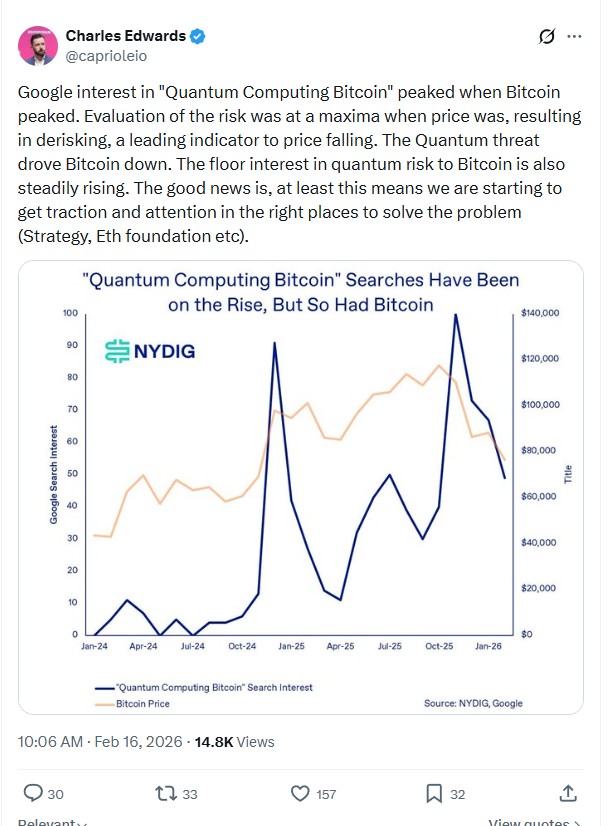
Capriole also believes quantum computing fears are affecting Bitcoin’s price, which may be why Back has started to take the topic seriously.
“I think he’s getting in the picture now that if we don’t solve this, even if it doesn’t happen for longer than expected, the risk of it happening is too great, and it’s discounting the value of Bitcoin.”
Bitcoin’s quantum problem #3: Post-quantum signature sizes are massive
The current crop of post-quantum signature schemes is 10 to 100 times larger than Bitcoin’s existing elliptic curve Schnorr signatures.
“The issue with large quantum signatures is that it…
cointelegraph-magazine.com