


-
Search results are becoming part of the crypto attack path
Search engine results have quietly become one of the most underestimated weaknesses in cryptocurrency security.
The usual understanding of crypto security focuses on protecting seed phrases, using hardware wallets, enabling multi-factor authentication and being careful with suspicious links sent through email or direct messages. What is often missed is the role of search engines as an entry point for attacks.
For years, platforms such as Google have been seen as neutral gateways to the internet. Users are used to searching for their bank, favorite restaurant or a decentralized finance (DeFi) protocol, assuming the results are reliable. Scammers are now taking advantage of that behavior in crypto.
Recent incidents involving fake ads that impersonate major cryptocurrency platforms show that search engines are no longer just neutral information tools. Scammers have turned them into part of the attack surface targeting crypto users.
A wallet compromise does not always begin when a user connects to a malicious site. It may start several minutes earlier, with a normal search query and one wrong click.
-
How search engines became a crypto security risk
Traditional cyberattacks usually focused on technical weaknesses, such as software flaws, server exploits and malware. Modern crypto fraud works differently.
Instead of targeting systems, attackers target behavior.
Decades of internet use have trained users to trust search results, especially the ones that appear at the top of the page. A “Sponsored” label does not always make users more careful. Some may even see it as a sign that the listing is legitimate. They may also wrongly assume that the company behind the ad has been verified.
Neither assumption is always safe.
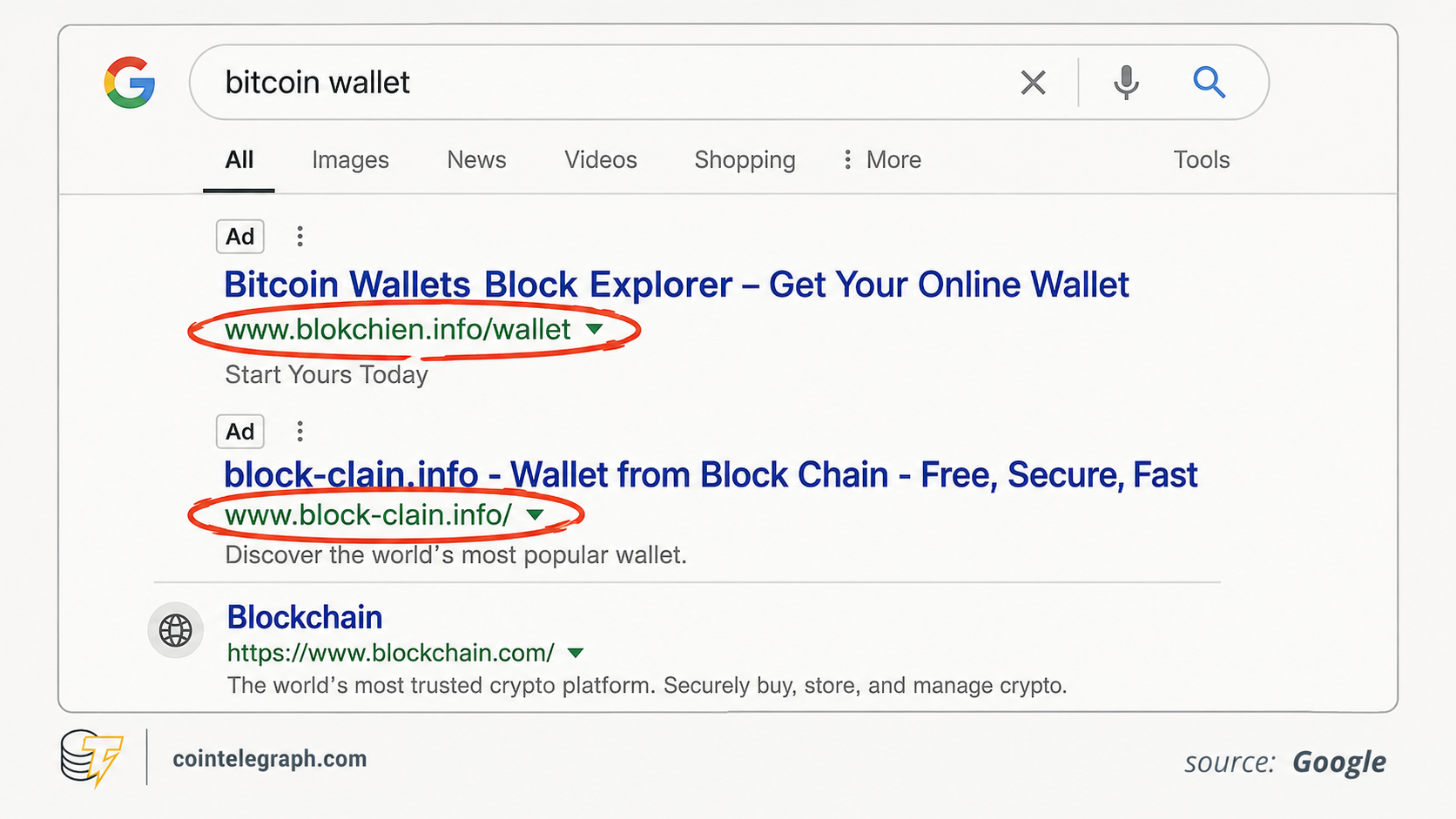

Search engines are designed to organize information and sell ads. Skilled bad actors understand both systems well. They can buy ad placements, manipulate visibility, copy trusted brand identities and reach users when they are most likely to act.
In crypto, that can be dangerous. A single transaction can move large sums instantly and usually cannot be reversed. That means one wrong click can have serious financial consequences.
Did you know? Google was not originally called Google. Its founders developed it as a research project called “BackRub,” named after its ability to analyze backlinks. Today, that same search system influences trillions of dollars in online activity, including crypto transactions.
-
The Uniswap impersonation campaign
A recent incident shows how effective this method can be. According to recent reports, attackers stole at least $400,000 from a trader through fake Google ads that impersonated the decentralized exchange Uniswap.
The method was simple. A user searching for “Uniswap” would see what appeared to be an official sponsored listing near the top of the results. The branding looked familiar and the message seemed credible. This gave users little reason to be suspicious.
Clicking the ad took users to a cloned interface that closely copied the real Uniswap platform. From there, the experience looked genuine. Users connected their wallets, started what seemed like normal transactions and granted the required approvals.
The consequences became clear only later. The users had unknowingly approved permissions that allowed the attackers to withdraw funds directly from their wallets.
What makes this attack different is the lack of technical intrusion. The attackers did not need seed phrases, malware or broken encryption. The victims themselves signed the transactions that enabled the theft.
-
Why even experienced users fall victim
It is easy to assume that only newcomers to cryptocurrency fall for such schemes. In reality, even experienced users can be tricked under the right conditions.
One reason is authority bias. People naturally place trust in established institutions and systems. Google, in particular, is widely seen as a reliable way to find information. Users often assume that top search results are checked carefully before they appear.
Habit makes the problem worse.
For decades, the search bar has been the default way to move around the internet. Many users no longer memorize URLs. They simply search for the platform they want to visit.
Convenience also encourages speed.
Regular DeFi users often move quickly between exchanges, staking services, governance portals and bridge interfaces. The more urgent the action feels, the less likely users are to check every detail in front of them.
Attackers know this. They spend time and money creating convincing copies of trusted platforms. A fake interface that closely matches a familiar platform can lower even an experienced user’s guard, especially when that user is distracted or in a hurry.
There is also optimism bias. People may know that a threat exists but still believe they are unlikely to become the victim. Crypto’s track record gives little reason for such…
cointelegraph.com